Airbus Helicopters and Quantum Systems have announced a partnership aimed at integrating advanced counter-unmanned aerial system (C-UAS) capabilities into Airbus military helicopter platforms.
The collaboration will initially focus on the H145M multi-role helicopter, with both companies working to expand the aircraft’s ability to detect, track, and defeat emerging drone threats.
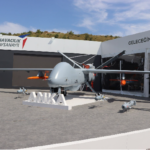
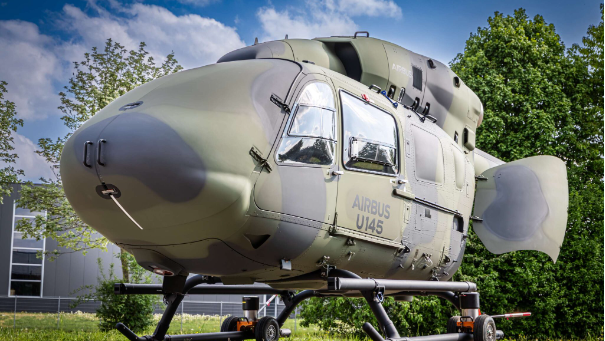
While technical details remain limited, Airbus offered an early look at the concept during ILA Berlin 2026. A mock-up of the unmanned U145 variant displayed at the event featured two drone interceptor systems mounted on external weapon stations, illustrating a potential future operational configuration.
U145 Autonomous Helicopter Concept
The U145 is an unmanned derivative of the H145M and has been designed to support a broad range of military and civil missions. The platform features a maximum takeoff weight of 3,800 kilograms (8,378 pounds), an operational range of approximately 650 kilometers (404 miles), and endurance exceeding three and a half hours.
Its modular design allows it to perform missions such as reconnaissance, surveillance, disaster relief, firefighting support, and drone deployment operations.
Airbus is also cooperating with MBDA on crewed-uncrewed teaming technologies that could further enhance the operational flexibility of the platform.
According to Airbus Helicopters Executive Vice President of Programs Stefan Thomé, the agreement with Quantum Systems represents an important step toward broadening the capabilities of military helicopter fleets and improving their ability to counter unmanned threats in contested airspace.He emphasized that the H145M’s open architecture and upgrade potential make it an ideal platform for integrating next-generation counter-drone technologies while supporting broader European defense and technological objectives.
Quantum Systems Unveils PULSE P19
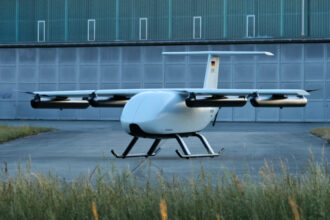
Separately, Quantum Systems introduced its new PULSE P19 aircraft, an optionally manned medium-altitude, long-endurance platform equipped with integrated counter-drone capabilities.
Like the U145 concept, the PULSE P19 features interceptor drones mounted on external hardpoints and is designed to engage a variety of airborne threats.
The company stated that one of the aircraft’s primary functions is the detection, tracking, and neutralization of asymmetric aerial targets operating at low altitudes. To achieve this, the platform combines onboard radar systems with advanced electro-optical and infrared sensors capable of identifying and monitoring long-range strike drones.
Quantum Systems explained that the complete engagement chain—from threat detection to interceptor deployment and target engagement—is managed through its MOSAIC UXS architecture. The process can be controlled either directly by the pilot or remotely during unmanned operations.
The partnership between Airbus and Quantum Systems reflects the growing emphasis on counter-drone technologies as armed forces adapt to increasingly complex aerial threat environments dominated by unmanned systems.