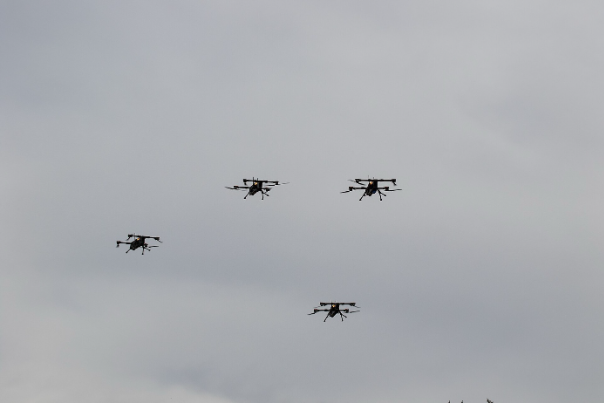
Spain has officially initiated the FENIX Project, a defense research program focused on creating a new generation of autonomous drone swarm capabilities built around multiple types of unmanned aerial vehicles operating as a coordinated network.
The initiative combines aerial platforms developed by Alpha Unmanned Systems with navigation and flight-control technologies supplied by UAV Navigation-Grupo Oesía.
Rather than functioning as separate aircraft following predetermined routes, the envisioned system is designed to allow multiple drones to cooperate as a unified operational entity, continuously exchanging information and adapting to changing battlefield conditions.
CollaborativeAutonomous Operations
One of the project’s primary objectives is to enable real-time data sharing between drones, allowing the swarm to collectively modify flight paths and mission behavior without requiring direct human intervention.
The system will incorporate a cooperative perception architecture in which sensor information gathered by individual drones is distributed across the network. This approach is intended to maintain a common operational picture even when some aircraft temporarily lose direct visibility of a target or operating area.
Developers are also working on navigation technologies capable of operating in GPS-denied environments. The capability would allow the swarm to continue mapping terrain, identifying objectives, and conducting reconnaissance missions even when satellite navigation signals are disrupted or jammed.
DesignedforComplexMissionEnvironments
According to project participants, the FENIX swarm is expected to support operations in hazardous environments, including areas affected by chemical, biological, radiological, or nuclear threats.
The architecture is being developed with flexibility in mind, enabling future use across a wide range of missions such as surveillance, reconnaissance, patrol duties, and search-and-rescue operations.
As part of the program, a technology demonstrator will be produced and subjected to a series of simulations and flight tests to evaluate its performance.
Researchers will examine how the swarm performs compared with conventional surveillance systems, particularly in electronically contested environments where communications and navigation systems may be degraded.
The FENIX Project is being conducted under Spain’s COINCIDENTE defense innovation framework, a national research and development initiative established by the Ministry of Defence to support emerging military technologies and accelerate their transition into operational capabilities.
The program reflects a broader trend among modern armed forces toward autonomous, networked drone swarms capable of performing complex missions with minimal human oversight while maintaining resilience in contested environments.