In a direct response to the evolving threat of “saturation attacks,” Japan’s Acquisition, Technology & Logistics Agency (ATLA) concluded a series of high-stakes field tests this week, successfully demonstrating a vehicle-mounted High-Power Microwave (HPM) weapon capable of neutralizing dozens of drones simultaneously.
The trials, conducted at a remote testing range in the Kyūshū region, represent a significant leap in Japan’s “Integrated Air and Missile Defense” strategy, shifting the focus from single-target intercepts to wide-area electronic denial.
Beyond the Laser: Why Microwaves?
While much of the global defense conversation has centered on lasers (LDEW), the JSDF’s latest HPM system addresses a critical tactical gap: the ability to handle swarms.
Area of Effect: Unlike lasers, which must “dwell” on a single point to melt through hardware, the HPM system emits a wide-angle pulse of electromagnetic energy. This fries the internal circuitry of any drone within its “cone of effect” instantly.
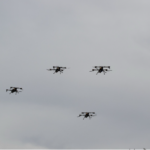
Speed of Engagement: During this week’s tests, the system reportedly disabled a coordinated swarm of 40 loitering munitions in under five seconds.
All-Weather Performance: HPM systems are less affected by atmospheric conditions like heavy fog, smoke, or rain, which can often diffuse and weaken traditional laser beams.
The “Fortress Islands” Strategy
Military analysts in the Indo-Pacific suggest that these HPM units are destined for deployment on Japan’s southwestern islands. As tensions remain high regarding maritime borders, the HPM “shield” provides a non-kinetic way to enforce airspace without necessarily escalating to lethal, explosive force.
“We are moving toward a ‘layered’ defense,” noted a senior ATLA engineer. “The lasers handle the long-range high-speed threats, but the HPM is our ‘electronic shotgun’ for the swarms that try to overwhelm our sensors.”
The Energy Paradox
The primary hurdle for the 2026 rollout remains the massive power requirement. The current prototype is integrated into a heavy-duty 8×8 truck chassis, which houses a dedicated high-capacity capacitor bank. Japan is reportedly looking into next-generation solid-state batteries to reduce the footprint of the system, potentially allowing it to be mounted on smaller, more agile unmanned ground vehicles (UGVs).
Strategic Takeaway
The successful test marks Japan as a frontrunner in the “Electronic Warfare Renaissance.” By proving that a mobile unit can create a temporary “no-fly zone” for electronics, Tokyo is signaling to regional competitors that the era of low-cost drone dominance may be meeting its mechanical match.
“The goal isn’t just to shoot them down,” said a regional defense consultant. “It’s to make the very idea of a drone swarm obsolete before it even launches.”
Technical Snapshot:
Effective Range: Classified (Estimated 3-5km for small UAVs).
Cooling System: Advanced liquid-immersion cooling for rapid-fire pulses.
Platform: Mitsubishi Heavy Industries (MHI) 8×8 Tactical Truck.
Targeting: AI-assisted multi-object tracking radar.
Would you like the next report to cover developments in underwater autonomous docking or perhaps the latest hypersonic glider tests in the Southern Hemisphere?