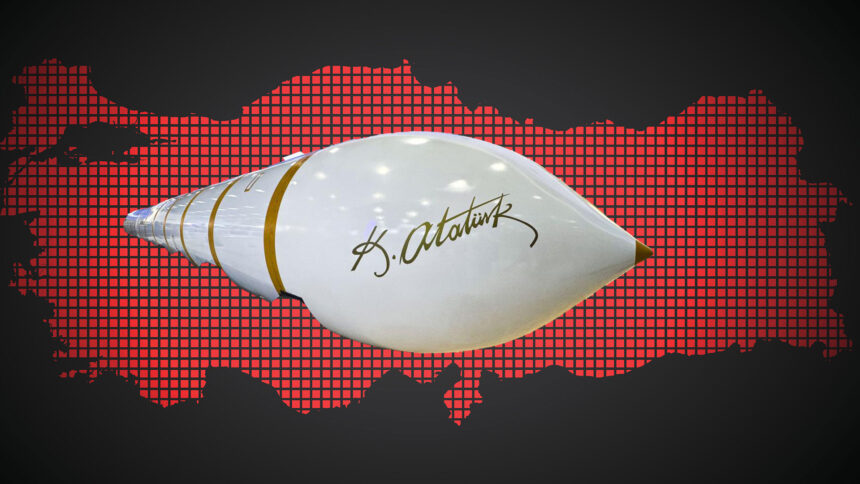
When the curtain lifted at Istanbul’s SAHA 2026 International Defense, Aerospace, and Space Industry Fair on May 5, a single exhibit commanded the attention of military watchers around the world: a tall, white missile bearing on its nose the signature of Mustafa Kemal Atatürk and on its body the tughra — the imperial seal — of Ottoman Sultan Yıldırım Bayezid. The weapon is called Yıldırımhan, meaning “lightning,” and it represents something far more consequential than a piece of hardware on display. It is the most visible symbol yet of Turkiye’s deliberate, decades-long transformation into a formidable and increasingly autonomous defense industrial power.
A Long Road to Strategic Autonomy
To appreciate what Yıldırımhan means, one must first understand the journey that produced it. In 2002, Turkiye’s private defense industry turnover stood at roughly $1 billion. It was a country that relied on foreign suppliers for approximately 80 percent of its defense needs — and was repeatedly reminded of that dependency in uncomfortable ways. The United States imposed an arms embargo following Turkiye’s military intervention in Cyprus in the 1970s. Germany banned arms exports over concerns about their use in southeastern Turkiye in the 1990s. And in 2020, Washington sanctioned Ankara under the Countering America’s Adversaries Through Sanctions Act (CAATSA) after Turkiye purchased the Russian S-400 air defense system — a move Ankara justified by pointing to its NATO allies’ long-standing refusal to provide comparable systems on acceptable terms.
The cumulative effect of these episodes was not submission. It was resolve. Turkiye’s government, particularly under the AKP since the early 2000s, made defense self-sufficiency a national priority. The results are now difficult to dispute. By 2025, Turkiye’s defense and aerospace exports had reached approximately $8.5 billion for the year — more than four times the figure from just five years earlier. Foreign dependency, once at 80 percent, has been driven down to around 20 percent. Five Turkish companies — Aselsan, Turkish Aerospace Industries (TUSAŞ), Baykar, Roketsan, and the state-run MKE — now appear in SIPRI’s annual ranking of the world’s top 100 arms producers, with combined revenues of over $10 billion in 2024. SIPRI places Turkiye among the world’s top 15 defense exporters.
The Bayraktar TB2 drone became the most globally recognized symbol of this transformation. Exported to over 35 countries — from Ukraine to Mali, from Bangladesh to Japan — the TB2 redefined what affordable, combat-proven unmanned warfare could look like. But drones, however successful, operate within relatively constrained envelopes. Yıldırımhan is a different kind of statement entirely.
What We Know About the Missile
Developed by the Ministry of National Defense’s own R&D Center — not by a private contractor — Yıldırımhan is Turkiye’s declared first intercontinental ballistic missile. According to technical specifications displayed at SAHA 2026, it carries a 3,000-kilogram payload, reaches speeds between Mach 9 and Mach 25, and is powered by four liquid-fuel rocket engines using nitrogen tetroxide and unsymmetrical dimethylhydrazine (UDMH) — propellants now produced domestically. Its stated range is 6,000 kilometers.
A number of caveats must be acknowledged honestly. What was unveiled at SAHA 2026 was a prototype in mock-up form. No confirmed flight tests have been publicly documented. Independent verification of its technical specifications remains unavailable. The choice of liquid propellant — while proven and capable of heavy lift — introduces longer fueling times compared to solid-fuel alternatives, reducing readiness under pre-emptive strike scenarios. Analysts have noted these limitations, and Turkiye’s Defense Ministry has acknowledged that field tests are still ongoing. Yıldırımhan is a developmental platform, not a deployed operational weapon.
That said, the program’s ambitions appear serious. The R&D Center’s chief developer confirmed that rocket motor development was completed in 2024 and that fuel — previously not manufactured in Turkiye — is now in domestic serial production. The head of the Ministry’s R&D Center described a development timeline spanning approximately a decade, suggesting this is not a rushed display item but the culmination of sustained institutional investment. In this respect, what was shown at SAHA was less a finished product than a credible proof of concept backed by demonstrated technical progress.
The Geography of 6,000 Kilometers
A range of 6,000 kilometers traces a large and consequential circle on any map. From Istanbul, such a missile could theoretically reach targets across all of Europe, the entire Middle East and North Africa, the Caucasus, Central Asia, the Indian subcontinent, and portions of sub-Saharan Africa. It falls just within the technical threshold commonly used to define intercontinental ballistic capability.
This geography has not gone unnoticed in regional capitals. In Jerusalem, the unveiling generated pointed commentary, coming as it did against the backdrop of sharply deteriorating Turkish-Israeli relations. Analysts in Tel Aviv noted that while Turkiye and Israel share no formal military confrontation, their strategic interests have diverged significantly, and the political relationship between Ankara and the current Israeli government has reached its lowest point in decades. Turkiye’s president has been among the most vocally critical world leaders regarding Israeli military operations in Gaza. Whether or not the Yıldırımhan program was designed with any specific adversary in mind, the geographic realities are plain for analysts across the region to read.
In Athens, the missile’s reveal arrives in the context of an ongoing, if managed, rivalry with Turkiye in the Aegean and Eastern Mediterranean. Greece and Turkiye remain NATO allies with unresolved disputes over maritime boundaries, airspace, and the status of Cyprus. Long-range Turkish strike capability, even in prototype form, will factor into Greek strategic calculations. In the Arab world, reactions vary by alignment: Gulf states with close ties to Ankara are watching cautiously, while those wary of Turkish regional influence — in Libya, Syria, or beyond — have added another data point to their assessments.
Russia and Iran occupy a distinct position. Both possess their own advanced ballistic missile programs and are unlikely to be operationally destabilized by a Turkish ICBM prototype. But they are certainly attentive to the signal: a NATO member developing sovereign long-range strike capability independent of alliance structures is a geopolitical variable with implications that extend well beyond Turkiye’s borders.
The Strategic Logic Behind the Signal
Turkish Defense Minister Yaşar Güler’s statement at the launch — “let no one have any doubt that, if necessary, we will use it without hesitation” — was as much doctrine as declaration. It captures the essence of what Yıldırımhan is intended to communicate: that Turkiye intends to be treated as a power with independent strategic reach, not merely a capable regional actor or a useful but dependent alliance partner.
This logic is not difficult to understand in Ankara’s terms. Turkiye has spent decades watching its security requests met with delays, conditions, or outright refusals. The S-400 episode crystallized a frustration that had been building since the Cyprus embargo. In this context, the development of sovereign deterrent capability — including, eventually, long-range strike — is the rational institutional response of a state that learned it could not always rely on others to provide for its security on acceptable terms. The defense industry buildup is simultaneously an economic strategy, a geopolitical positioning tool, and a form of insurance.
There is also an indirect dimension worth noting. Defense analysts have pointed out that the physics of ICBM trajectories and the physics of reaching orbital altitude overlap significantly. Turkiye’s civilian space launch program, the Delta-V initiative, seeks to place Turkish satellites into orbit using domestically produced rockets. An ICBM-class development program is, in technical terms, a natural — if politically consequential — parallel track to a serious space program. The dual-use nature of the underlying technology means that progress in one domain advances the other.
A Club of Few
In entering the domain of ICBM development, Turkiye joins an exceptionally small group of states: the United States, Russia, China, France, the United Kingdom, India, and North Korea have demonstrated this capability. Israel is widely believed to possess it. For a NATO member — and a country that hosts American nuclear weapons as part of the alliance’s nuclear sharing arrangements — the development of a sovereign long-range ballistic missile of this class is, to put it plainly, without precedent. It raises questions about how NATO allies, particularly the United States, will respond over the longer term as the program matures toward operational status.
It also raises questions that Turkiye itself has not yet fully answered publicly: about command and control architecture, about the circumstances under which such a system would be used, and about its relationship to alliance commitments. These are not trivial details. They are the substance of strategic credibility.
Conclusion: Thunder with Caveats
Yıldırımhan is simultaneously an impressive milestone and a project still in early development. The fact that Turkiye has developed the domestic industrial capacity — including sovereign fuel production and rocket motor capability — to even attempt an ICBM is remarkable given where the country stood two decades ago. The trajectory of the broader defense industry, from the Bayraktar drones to the KAAN fifth-generation fighter now entering serial production, from Aselsan’s surging electronics exports to Roketsan’s growing missile portfolio, confirms that this is not a single leap but the latest step in a sustained, coherent industrial transformation.
At the same time, realism demands acknowledging what has not yet been demonstrated: flight tests, operational deployment, verified performance, and a fully articulated strategic doctrine governing the missile’s potential use. The distance between a compelling prototype at a defense fair and a credible operational deterrent is measured in years, testing cycles, and enormous institutional effort.
What is already clear is that Turkiye’s neighbors, allies, and rivals are watching — and recalibrating. The lightning has been named. Whether it will strike, and where, remains an open question. But that a NATO member state could plausibly ask it is, by itself, one of the more consequential strategic developments in the region in many years.
Sources: Al Jazeera, Warsight, Defence Security Asia, SIPRI 2024 Arms Industry Database, Daily Sabah, DefenceWeb, Turkish Minute, Türkiye Today.