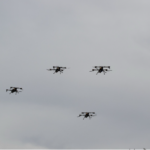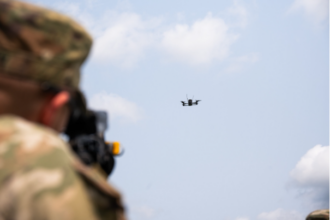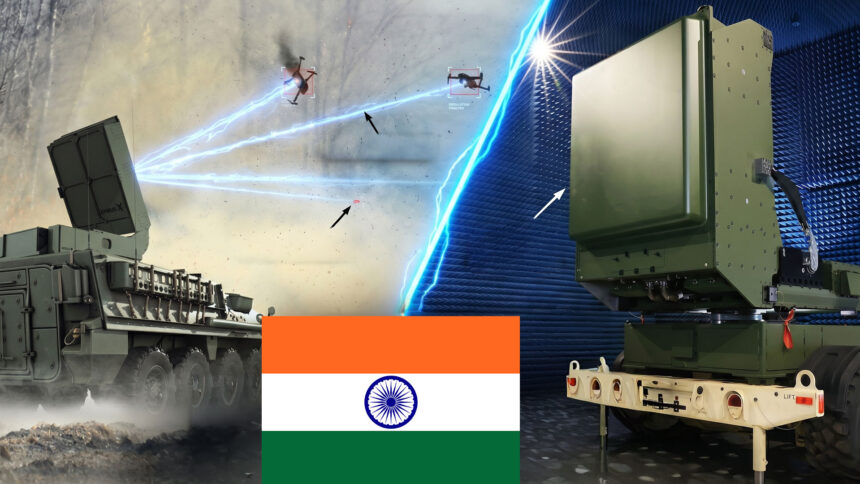
Modern battlefields are facing a paradigm shift driven by an affordable yet terrifying adversary: the drone swarm. Consisting of dozens of cheap, commercially available, or low-cost military quadcopters, these swarms are designed to saturate airspace and overwhelm sophisticated defense networks. The tactical dilemma they present is brutal in its asymmetry. Traditional air defense systems rely on multi-million dollar interceptor missiles to neutralize a threat that costs only a fraction of that amount. This creates an economic war of attrition where defenders risk bankrupting themselves just to stay safe. Seeking to completely rewrite the rules of this engagement, India’s Defence Research and Development Organisation (DRDO) has taken a massive leap into the future by developing a high-power microwave (HPM) weapon system. With a critical testing phase targeted for conclusion in June 2026, this technology aims to neutralize mass aerial threats without firing a single bullet.
The core physics driving this high-power microwave weapon is both elegant and devastating. While kinetic weapons aim to physically destroy a hull, this directed energy system targets the digital nervous system of the target. Every contemporary unmanned aerial vehicle (UAV) relies heavily on a complex array of microchips, GPS receivers, flight controllers, and delicate sensors. When the HPM system unleashes its intense, invisible pulse, it induces high-voltage transients within these internal circuits. This sudden surge effectively fries the electronics, causing an instant, irreversible short circuit. Stripped of their digital guidance, the sophisticated drones are instantly transformed into useless shells of plastic and metal that plummet harmlessly to the earth.
What makes India’s strategic pivot toward high-power microwaves so vital is the distinct advantage it holds over other directed energy systems, such as lasers. A laser weapon operates on a point-defense principle, focusing a highly concentrated, narrow beam of light onto a specific target to melt its casing. This requires precise tracking and time to burn through, making it ideal for taking down individual, high-value threats one by one. In contrast, an HPM weapon radiates its energy in a expanding, wide-angle cone. Instead of picking off isolated targets, it bathes an entire sector of the sky in a dense wave of electromagnetic energy. This broad coverage makes it the ultimate countermeasure against swarms, allowing a single deployment to incapacitate dozens of coordinated drones simultaneously.
This development is deeply tied to India’s broader geopolitical objectives and its “Atmanirbhar Bharat” (self-reliant India) defense initiative. Historically dependent on importing top-tier military hardware from global powers like Russia, the United States, and France, India is utilizing the DRDO’s research centers to establish itself as a primary innovator rather than a consumer. Developing high-power microwave technology domestically places the nation in an exclusive club of advanced militaries, alongside the United States and China, who are actively pioneering operational directed energy weapons.
The economic realities of this technology are just as revolutionary as its tactical capabilities. In a standard combat scenario, an adversary can launch a swarm of drones worth a few thousand dollars, forcing the defender to deplete an inventory of surface-to-air missiles that cost hundreds of thousands of dollars each. Attackers exploit this disparity to exhaust defensive stockpiles. By shifting to a directed energy architecture, the cost per shot drops to a mere fraction of a dollar, limited only by the fuel or electricity needed to power the generator. This completely reverses the economic equation of modern warfare, making mass drone attacks financially unviable for the attacker.
Ultimately, this technology offers a glimpse into a chillingly quiet future of military engagement. The loud, chaotic sounds of traditional anti-aircraft artillery and missile launches are replaced by a profound silence, where entire fleets of hostile machines are silently neutralized mid-air by invisible waves of physics. As the final evaluation rounds wrap up, India is positioning itself not just to survive the drone era, but to dominate the electromagnetic spectrum that governs the modern theater of war.